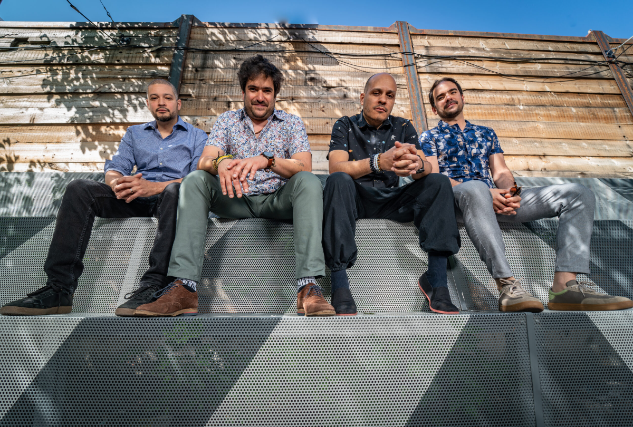
On NUEVA TIMBA, the new Blue Note album from the Cuban-born pianist HAROLD LOPEZ-NUSSA, the jazz vanguard meets multiple eras of Cuba’s musical history with results that are at once accessible, life-affirming and strikingly accomplished. Featuring a core of unmatched talent — Harold’s brother, Ruy Adrian López-Nussa, on drums; Luques Curtis on bass; and the harmonica virtuoso Grégoire Maret — it feels like a definitive vision for the future of Latin jazz.
On “Bonito y Sabroso,” López-Nussa condenses the power of Benny Moré’s big band into a small-group arrangement, then adds modern, psychedelic hues through electronics and the beat-making of José Angel Blanco, a.k.a. El Negro WADPRO. Other highlights include “Niña Con Violin,” written by López-Nussa’s uncle, the acclaimed pianist Ernán López-Nussa, with gorgeous melodic bass work from Curtis. An arrangement of Ernesto Lecuona’s “Gitanerias” offers a master class in accenting classical virtuosity with a contemporary rhythmic thrust. The López-Nussa original “Cerca y Lejos” boasts welcome shades of early fusion-era Chick Corea.
For all its overwhelming mastery, however, this album is foremost a journey — a deeply personal narrative rooted in profound, often painful life changes.
NUEVA TIMBA tells the very real story of a man displaced: a young father finding his way in a new country while missing his homeland with heartrending intensity; all the while, he’s nursing other emotional wounds including the passing of his mother, and the compounding torment brings him to a state of despair. Slowly but surely, sunshine begins to poke through the clouds, and he discovers a path forward. Something like happiness returns to the horizon. Consider NUEVA TIMBA musical tears of joy.
The months and then years of the Covid-19 pandemic saw Harold López-Nussa living a strange and at times frightening dual existence. He was one of Cuba’s finest young pianists — an exhilarating presence at the world’s most important jazz festivals, and the most successful member of a musical dynasty that includes his father, the great drummer Ruy López-Nussa, and his uncle.
But every time he would return home to Havana after a tour, he’d find his beloved Cuba closer to oblivion. Food scarcity, inflation, continuing crises in energy, healthcare and agriculture: A nation that had been at the onset of a renaissance just a few short years prior was now in dire straits. “It was difficult to find food, even eggs. I mean, there was no coffee,” he says today, still in disbelief. What’s more, he’d been given a remarkable opportunity to sign with Blue Note Records — the home of not only his jazz-piano heroes like Bud Powell, Thelonious Monk, and Herbie Hancock but also Cuban piano titans including Chucho Valdés and Gonzalo Rubalcaba. Due to the embargo, however, he couldn’t accept a deal if he remained in Cuba.
So López-Nussa knew he had to make a change. But to where?He remembered his paternal grandmother, who was born in France and emigrated to Cuba in the 1960s, and how much he loved her and her home — a magical “little France” ensconced in the Caribbean, says López-Nussa. He chose Toulouse, in the south of France, for its beauty and pleasant weather, and carried out the excruciating task of telling his father about the move. “It was a big shock for him,” López-Nussa says. “Because my brother left also. So that means all my father’s grandchildren — my two daughters and my brother’s two sons — were leaving him. But he supported us 100 percent.”Unfortunately, when López-Nussa arrived in Toulouse toward the end of 2021, it didn’t match the quaint paradise he held in his mind’s eye. “It was gray every day,” he says. “It rained constantly.” He called a friend who’d recommended the picturesque “Pink City” and asked what the deal was. “Man,” his friend replied, “it’s almost winter.” That sodden, bleak weather overtook the pianist’s headspace as well, and for a long while, things only seemed to get worse.
“I have to say,” López-Nussa reflects, “that the first year in France for me was horrible. Horrible. I fell into a depression. Sometimes in my house, alone, I’d just cry. Like, what? I didn’t know what was happening to me.”
That’s how sorrow works: New traumas make older ones resonate within you once again, and before you know it, you’re besieged by a melancholy that doesn’t add up. In López-Nussa’s case, the unresolved grief of his mother’s passing returned in full force, and it remains something he struggles with. “It’s hard to speak about my mom because I miss her so much every day,” he says. As difficult as it may be, remembering his late mother also seems to bring him joy — especially when López-Nussa recalls his humble but richly loving upbringing in Havana. Half of the family’s two-room home doubled as a dining area and a space where his mother taught classical piano lessons — including the canon of Cuban classical music that had a tremendous influence on López-Nussa. Nearly two decades ago, when López-Nussa was in his early 20s, his mother suffered a stroke without warning “and did not recover,” he says pensively.
He recalls a joke he used to make with his mother as a music student: “Hey, mom, Sony Music called today and they want to make my album.” He pauses. “All these years later, it’s not Sony — it’s Blue Note. Incredible.”
NUEVA TIMBA is the second album López-Nussa has recorded for the label, following 2023’s Timba a la Americana. A live/studio hybrid, it was captured at the club Le Duc des Lombards, a jazz institution in Paris, and then tastefully reshaped and enhanced in post-production. The project’s aim or purpose is twofold. To start, it documents López-Nussa’s thrilling prowess as a live performer, while also embracing the pristine audio and conceptual ingenuity that’s possible in the studio. For example, a longer live medley including the Cuban standard “El Manisero” and the original “New Day” has been split into separate tracks and sequenced apart for programmatic effect — a touch of Teo Macero. In certain spots throughout the album, theatrical street-life chatter adds festive atmosphere.
The project also serves as a chronicle of López-Nussa’s ever more fulfilling life in France. He’s settled into a teaching position at the conservatory in Toulouse, which has expanded his own understanding of American jazz. His wife found a great job, and his daughters are enjoying school and learning to speak French — much more successfully than he is, López-Nussa admits with a laugh. One of his daughters is studying violin, and they’re working on a duet of “Niña Con Violin.”
As a performer, the move opened up new pathways of inspiration, including collaborations with French musicians and a newfound appreciation for the music of his homeland. “You look to Cuba in a different way,” he explains, adding that he no longer takes the history and tradition of Cuban music for granted. And his father visits often.
Still, in quiet moments, López-Nussa can’t help but think about his mother, and yearn for just one more day in her presence. “I want her to meet my daughters,” he says. “That’s what I’m missing the most. And I want her to listen to me playing piano today. I think she would be very proud of me.”