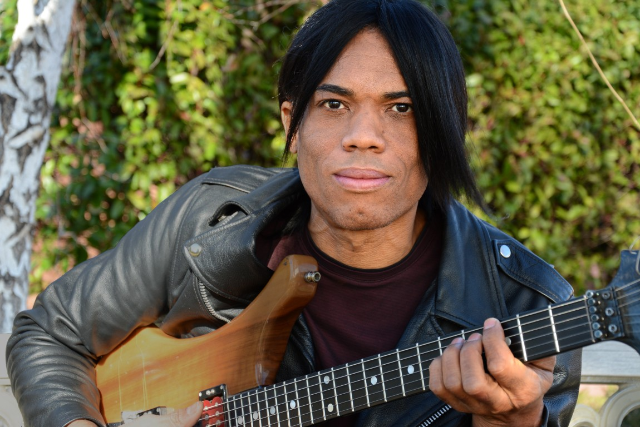
Today, Stanley Jordan announces the upcoming release of his long awaited album ‘Feather in the Wind’ by sharing his version of the song “Meditation,”originally written by the late Brazilian composer Antônio Carlos Jobim, which Stanley recorded in collaboration with the world-renowned, Brazilian singer-songwriter Milton Nascimento. The single arrives as a testament to a dream Stanley first conceived fifty years ago – and a document of a generation of Brazilian musical giants.
Nascimento was born and raised in Minas Gerais. Music occupies a central place in Brazilian culture, and within Brazil, Nascimento is widely regarded as the quintessential voice of Minas – someone whose singing seems to absorb and reflect the region’s landscape of rolling hills, lush and and echoing canyons. His voice lingers on individual notes with a delicate beauty that has drawn collaborators from across the jazz world, including ‘Native Dancer,’ a 1975 landmark project with Wayne Shorter and Herbie Hancock. It was Stanley's first hearing of that album in 1976 that first brought Nascimento's voice to his attention. "I was still a teenager then, and that album was deeply moving for me and very inspiring," Stanley recalls. "That's when the seed for this project was planted, because that's when I first dared to dream that Milton and I would collaborate someday." This recording of "Meditation" was made in 2014 at a boutique studio in the heart of Minas Gerais – nearly four decades after that seed was sown.
For this recording, Stanley was joined by three musicians he describes as his "Brazilian dream team": Dudu Lima, Ricardo Itaborahy, and the late Ivan Conti, known widely as Mamão. Lima and Itaborahy were frequent collaborators of Nascimento at the time of the session, lending the date an ease and familiarity that comes through on the recording. Mamão, a founding member of the legendary jazz-fusion group Azymuth, had been a fixture of Brazilian music for decades. He passed away in 2023. "We had a lot of history together, having traveled and performed throughout Brazil," Stanley says. "I was thoroughly honored and overjoyed for everyone’s contribution to this project."
The arrangement weaves together both the original Portuguese lyrics and their English counterpart. Stanley had initially envisioned a more intricate interweaving of the two languages, but Nascimento proposed a different approach in which the Portuguese lyrics carry the bulk of the song and English appears only at the close. "Milton’s idea keeps the languages more separate so each can breathe on its own," Stanley explains. "His solution was better, so we went with it."
Stanley is well known for his distinctive touch technique, but on this track, he plays the guitar conventionally, using a pick. He explains,“I played mainly with a pick before developing the touch technique, so this takes me back to my roots as a guitarist.” Despite this more conventional approach, the sound of Stanley’s unique musical voice is still immediately recognizable – something he attributes in part to his focus on melody. “I’ve always placed a high value on melodicism, which is something that sometimes gets lost in today’s jazz world” he explains.
Stanley's guitar work on the track also reflects a lineage he holds dear. His first exposure to "Meditation" came through Joe Pass's recording on the album ‘Intercontinental.’ "Joe was one of my favorite guitarists," he says. "I hope you can hear the influence and my loving regard for his playing on this track." Jobim's broader legacy in jazz — long considered essential listening for any serious student of the form — adds another layer to Stanley's approach.
With Mamão deceased and Nascimento now retired from large-scale touring, this recording stands as an extremely special, unlikely reunion of voices.